
How Often Do You Need to Test and Tag in Canberra?
March 16, 2026
How often electrical equipment needs to undergo testing and tagging in Canberra is not just a box‑ticking exercise. It sits at the heart of workplace safety, legal compliance and business continuity. Different workplaces face very different test and tag intervals depending on whether equipment is used in construction offices, workshops or hostile environments. Electrical Testing & Compliance Services (ETCS) unpacks how local and national regulations apply, what influences retesting frequencies and how businesses can align their schedules with AS/NZS 3760 and Work Health and Safety (WHS) obligations.
You will see how the risk level, environment and equipment type drive inspection and testing timelines across workplaces. ETCS walks through practical examples of common intervals for offices, construction sites and industrial facilities; explains how to interpret tagging information; and clarifies the difference between mandatory requirements and best practice. Understand what timeframe is appropriate for their site, how often different items should be tested and tagged and how a structured programme can reduce risk, avoid penalties and help keep people safe at work.
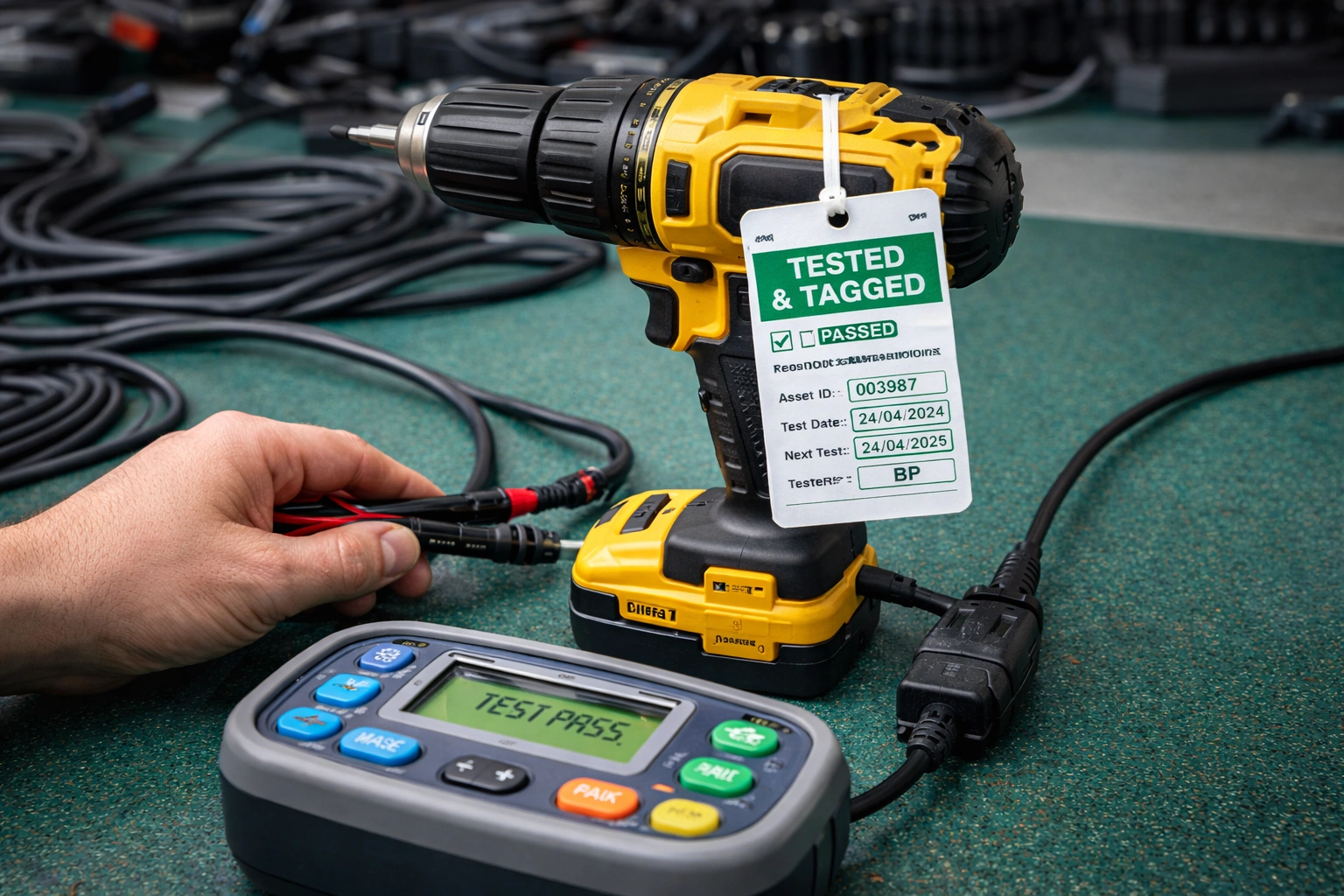
In the ACT, electrical test and tag is not just a “good idea”; it is a legal duty under workplace health and safety law. Businesses and PCBUs in Canberra must ensure portable electrical equipment is regularly inspected, tested and maintained so it is safe to use.
The ACT largely adopts the national WHS framework. That means the key requirements come from the Work Health and Safety Act 2011 (ACT), the Work Health and Safety Regulation 2011 (ACT) and the referenced Standard AS/NZS 3760, which sets out how often different types of equipment must be tested.
Under the WHS Act 2011 (ACT), a person conducting a business or undertaking must ensure, so far as is reasonably practicable, that workers and others are not exposed to electrical risk. In practical terms, this requires a business to:
The WHS Regulation 2011 (ACT) deals with electrical safety. It requires that electrical equipment used in hostile operating environments is regularly inspected and tested by a competent person. Hostile environments include areas where equipment is exposed to moisture, heat, vibration, dust or mechanical damage such as construction sites, workshops, warehouses, commercial kitchens and many outdoor work areas.
While the regulation sets the obligation, the accepted guide for how often to test is AS/NZS 3760. Specialists apply these intervals unless a risk assessment shows a need for more frequent testing. Typical minimum frequencies include:
These are minimums. If equipment is damaged frequently or used very heavily, shorter intervals following a risk assessment are recommended.
The regulation requires that electrical testing be carried out by a competent person. In practice for compliance with AS/NZS 3760, this means someone who:
Using an experienced test and tag provider helps satisfy this requirement and reduces liability for the business.
A compliant one must also include records. AS/NZS 3760 expects:
If an item fails the test, the law expects it to be taken out of service immediately, clearly labelled and either repaired by a licensed electrician or disposed of so it cannot be used again.
AS/NZS 3760 sets out how often electrical equipment must be tested and tagged based on the level of risk in the environment, not just the type of appliance. In practice, this means a drill used in a construction site must be checked far more often than a computer in a quiet office. Understanding the correct interval is essential so businesses stay compliant and minimise the chance of electric shock or fire.
Test and tag professionals apply the AS/NZS 3760 intervals across different workplaces, then tailor testing schedules to each business’s mix of equipment, work activities and site conditions. Below are the key intervals most businesses need to know.
Construction, demolition and similar high-risk sites have the strictest requirements because portable equipment is exposed to frequent movement, impact, dust and moisture. Under AS/NZS 3012, which is read alongside AS/NZS 3760 for construction work:
If a business operates a workshop that supports construction activities, specialists will often align those tools with the 3-month cycle to avoid gaps when equipment moves between the workshop and site.
For environments classed as hostile, where equipment is exposed to heat, vibration, moisture, chemicals or physical damage, the intervals are shorter. Common examples include manufacturing plants, automotive workshops, commercial kitchens and warehouse loading areas.
Typical intervals drawn from AS/NZS 3760 are:
In non-hostile commercial environments such as offices, retail stores and administration areas, test intervals are longer. Desktop computers, monitors and similar IT equipment that remain largely stationary may be tested every 5 years if they are double-insulated and in a low-risk location.
Hostile conditions are not the only trigger for shorter intervals. The standard also identifies specific categories, such as:
How and where each appliance is used should be reviewed before setting a compliant interval under AS/NZS 3760. If conditions change, such as an office space being converted into a workshop, the test and tag schedule should also be adjusted so the business remains aligned with the standard.
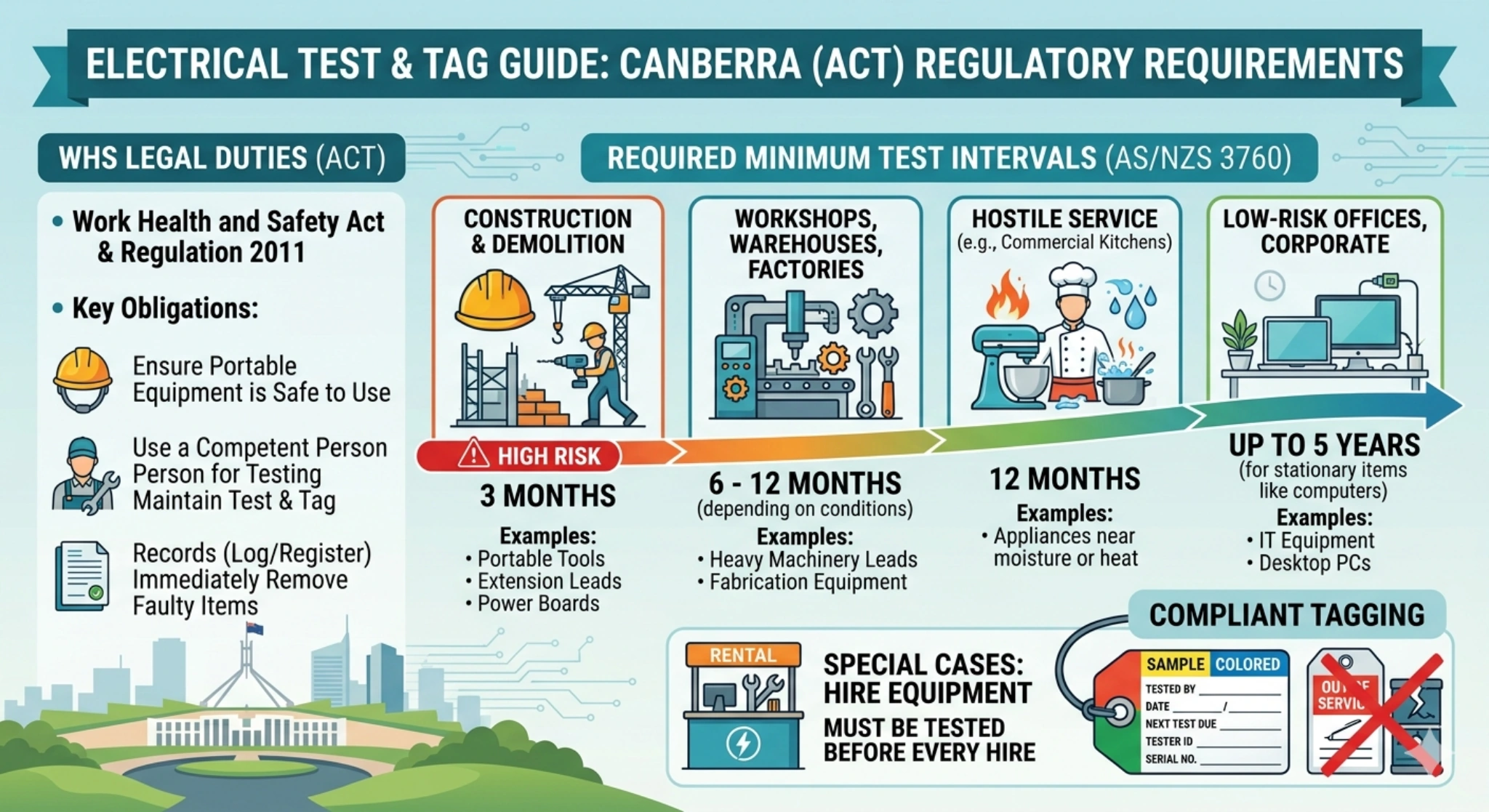
Testing and tagging intervals are not one-size-fits-all. How often equipment must be inspected depends heavily on the workplace environment and how, where and by whom the equipment is used. The harsher or more unpredictable the conditions, the more often items must be checked to stay compliant and safe.
Professionals base its recommendations on AS/NZS 3760 along with workplace safety expectations. Below are the main workplace types and the typical inspection patterns that apply to each.
Standard offices, retail stores, libraries and similar low-risk environments usually have the longest testing intervals. Equipment is generally stationary, used in clean indoor conditions and less exposed to moisture, vibration or physical damage.
In these spaces, stationary items such as computers, monitors and printers may be tested at intervals of up to 5 years where the environment is genuinely low risk and the equipment remains in good condition. Items such as extension leads, power boards, portable heaters, phone chargers and kitchen appliances usually require closer attention because they are moved more often and are more likely to be damaged, overloaded or used in shared areas. In practice, these portable or frequently handled items are often placed on shorter testing intervals depending on how and where they are used.
Construction sites and similar high‑risk areas have the strictest testing and tagging requirements. Equipment is exposed to dust, water, vibration, impact and rough handling, increasing the chance of damage to plugs, leads and casings.
On construction sites, portable tools and leads normally require testing at least every 3 months. This includes items such as drills, grinders, drop saws, portable lighting and extension leads. Workshop environments such as fabrication shops, mechanical workshops and maintenance depots also face higher risk from metal swarf, oils and physical damage. In these spaces, testing intervals are usually between 6 and 12 months, depending on the level of risk and how often tools are used.
Some workplaces are classified as hostile because equipment is regularly exposed to heat, moisture, chemicals or frequent movement. This can include commercial kitchens, laundries, event venues, schools, childcare centres and healthcare facilities. In these areas, cords and appliances are more likely to be flexed, knocked, splashed or dropped, so testing is commonly carried out every 12 months or less for portable appliances and power leads.
Where equipment is provided to the public or used by many different users, such as in gyms, community centres and hotel guest appliances, risk increases again. Specialists generally recommend shorter inspection cycles for portable items that can be unplugged and moved by anyone.
Hire equipment is a special case. Any portable electrical item must be tested and tagged before each hire or on a very tight schedule because the condition and competence of the user cannot be controlled. This results in pre‑hire checks and documented test records so the hiring company can demonstrate compliance if an incident occurs.
Responsibility for electrical test and tag sits squarely with the person or business that controls the workplace. This is usually the PCBU (Person Conducting a Business or Undertaking) under WHS laws, not the electrical contractor. While a competent provider can help a business meet these duties, legal accountability still remains with the workplace.
Ignoring or delaying testing and tagging can lead to fines, disruption and serious safety incidents. ACT WorkSafe treats non-compliance as a breach of WHS legislation, which means penalties can apply even if no one has yet been injured.
In practical terms, the responsible party is usually:
They must ensure:
Using a competent service provider helps demonstrate due diligence, but it does not transfer the legal duty.
Inspectors look for more than just tags. Common issues include:
In a shared site, such as an office building, confusion often arises over who manages what. As a guide, building managers are usually responsible for fixed installation testing, while tenants are responsible for their own portable appliances.
If ACT WorkSafe identifies non‑compliance, it can:
Beyond fines, the real cost is often disruption. Faulty equipment can cause electric shock, burns, arc faults or fire, leading to injury, investigations, insurance complications and reputational damage.
How often electrical equipment should be tested and tagged in Canberra depends on more than a simple calendar reminder. The right interval is shaped by the environment, the type of equipment, how often it is moved or handled and the level of risk present in the workplace. When businesses understand these factors and apply the requirements of AS/NZS 3760 alongside their WHS duties in the ACT, test and tag becomes a practical safety measure rather than a routine administrative task.
A clear and well-managed testing programme helps identify damaged or unsafe equipment before it causes injury, disruption or compliance issues. Keeping accurate records, following the correct intervals and responding quickly when items fail inspection all play an important role in protecting workers and meeting legal obligations. With the right schedule in place, businesses can reduce risk, support safer day-to-day operations and show that electrical safety is being managed properly across the site.

.svg)
.svg)


