
Understanding Test and Tag Colour Codes and Intervals: A Practical Guide
January 28, 2026
Understanding test and tag colour codes and retest intervals is essential for any business responsible for workplace electrical safety. These systems help businesses reduce electrical risk, meet Australian compliance requirements and avoid equipment being removed from service during inspections or audits.
Here at ETCS, we regularly see compliance issues that do not stem from negligence, but from confusion around how testing intervals, colour codes and workplace environments actually interact in day-to-day operations. Business owners are often surprised to learn that using the wrong tag colour or applying the wrong testing frequency can result in otherwise safe equipment being treated as non-compliant.
This guide is written for business owners, site managers and host employers responsible for electrical safety across construction sites, workshops, offices, retail spaces and shared workplaces, particularly those arranging testing and tagging in Gold Coast environments. It explains how colour codes work in practice, how often equipment needs to be tested in different settings and how to manage electrical testing in a way that is clear, defensible and easy to maintain.
Colour codes in electrical tagging are used to provide an immediate visual check of whether electrical equipment is within its required testing period. In most workplaces, especially construction sites, workshops and shared commercial environments, colour is the first thing supervisors and safety officers look at when assessing whether equipment can remain in service.
In practical terms, this means equipment is often judged compliant or non-compliant before anyone reads the test date or checks records. If the tag colour does not match the current testing cycle required for the site, the equipment may be removed from use even if it has been tested recently.
For business owners, colour coding plays a critical role in avoiding unnecessary downtime and compliance disputes. Correct colour use helps ensure tools and appliances are accepted on site, reduces the risk of failed inspections and supports consistent electrical safety controls across different work areas. When colour codes are misunderstood or applied incorrectly, otherwise safe equipment can quickly become a compliance problem.
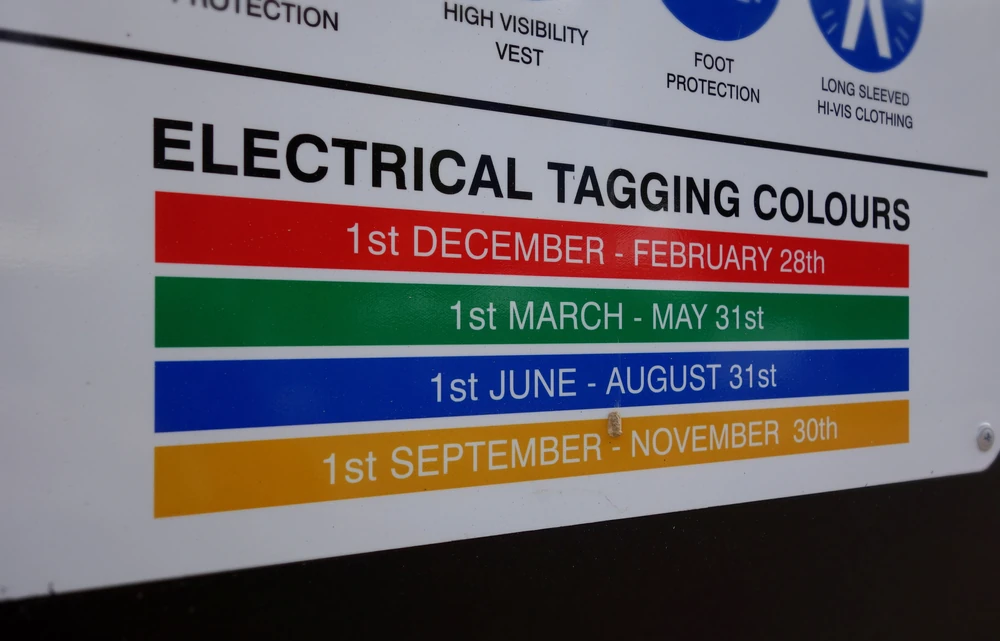
Many workplaces use a rotating colour tag system to quickly identify whether electrical equipment has been tested within the required period. The most commonly used system is known as the RGBY system, which uses red, green, blue and yellow tags.
Rather than simply indicating that equipment has been tested at some point, these colours are used to show which testing cycle the equipment belongs to. On sites with regular testing schedules, such as construction or industrial workplaces, the tag colour changes each cycle. Equipment displaying a colour from a previous cycle is treated as out of date, even if it appears to be in good condition.
In practical terms, the RGBY system allows supervisors and safety officers to confirm compliance at a glance. If the colour on the tag matches the current site cycle, the equipment is accepted for use. If it does not, the equipment is commonly removed from service until it is retested and correctly tagged. For business owners, this system reduces reliance on memory, paperwork or assumptions and helps maintain consistent electrical safety control across the workplace.
In Australian workplaces, colour coding is commonly used to make electrical test and tag compliance easy to identify at a glance, even though standards focus on testing intervals and risk rather than specific colours. The colour on the tag must accurately reflect the current testing period required for the environment where the equipment is used.
Green generally indicates equipment that has been tested and is within its current testing period. On many sites, green forms part of a rotating cycle and confirms the item is acceptable for use at the time of inspection.
Blue is often used to identify equipment subject to longer testing intervals, such as office, administrative or IT equipment used in controlled environments. It helps visually separate lower-risk equipment from tools used in harsher conditions.
Yellow is typically used as part of a rotating colour cycle and may indicate equipment approaching its next scheduled test, depending on site rules. It signals that the item remains compliant but will require retesting soon.
Red indicates equipment that has failed testing, has been deemed unsafe or is prohibited from use. Any item tagged red must be removed from service immediately and must not be used until it has been repaired, retested and correctly re-tagged.
It is important for business owners to understand that colour alone does not determine compliance. A tag is only compliant if the colour, test date and retest interval all align with the environment and site requirements where the equipment is being used.
Colour codes help businesses maintain electrical compliance between formal testing cycles. For business owners, they act as a practical control that ensures only equipment tested within the correct interval remains in use, without relying on memory, assumptions or constant reference to paperwork.
When colour tags are applied correctly, they make compliance visible in everyday operations. Supervisors and managers can quickly identify equipment that is overdue, incorrectly tagged or unsuitable for the environment it is being used in. This reduces the likelihood of non-compliant equipment being used unnoticed and helps prevent issues from escalating during audits or inspections.
Colour coding also strengthens accountability. When only equipment with the correct, in-date colour tags is permitted on site, responsibility for electrical safety is shared clearly across teams. This visual discipline supports safer decision-making and reduces reliance on informal checks that can fail under pressure.
When applied consistently, colour coding becomes a shared safety language across the workplace. Workers, supervisors, contractors and new starters can all interpret equipment status quickly without needing detailed technical knowledge or separate explanations.
For host employers and businesses managing multiple contractors, consistent colour use removes guesswork during handovers, toolbox talks and site inspections. Equipment acceptance becomes objective rather than subjective, reducing disputes and delays. This is particularly important on mixed-use sites where tools move between different work areas or teams.
Treating colour codes as part of everyday safety communication rather than just labels helps embed compliance into normal operations. Over time, this consistency improves safety culture and reduces the risk of electrical incidents caused by uncertainty or incorrect assumptions.
Testing intervals are not arbitrary. They are based on how equipment is used, where it operates and the level of risk it is exposed to. Applying the wrong interval can result in equipment being considered non-compliant, even if it appears to be in good condition.
Higher-risk environments such as construction sites, workshops and outdoor workplaces typically require more frequent testing. Equipment in these environments is exposed to movement, moisture, vibration and mechanical stress, increasing the likelihood of damage.
Lower-risk environments such as offices and retail spaces may allow longer testing intervals, provided equipment is used in controlled conditions and not frequently moved. Business owners must ensure testing intervals reflect actual usage, not assumptions about risk.
Electrical testing and tagging in Australia is guided by AS/NZS 3760, which sets out inspection and testing requirements based on risk. While testing is carried out by a competent person, businesses remain responsible for ensuring the correct intervals are applied to their equipment.
The standard follows a risk-based approach. Equipment exposed to harsher conditions or frequent handling must be tested more often than equipment in stable, controlled environments. Compliance is assessed not just on whether testing occurs, but whether it occurs at appropriate and justifiable intervals.
From a business perspective, this means testing programmes should be reviewed regularly. Changes to work environments, equipment use or site conditions may require adjustments to testing frequency to remain compliant and defensible.
Low-risk or controlled environments are workplaces where access is limited, conditions are stable and equipment movement is minimal. Examples include offices, server rooms and permanently wired plant areas with restricted access.
In these environments, standards may allow longer testing intervals, provided other controls are in place. However, extended intervals rely on ongoing vigilance. Visual inspections should still occur as part of normal operations, and any sign of damage or modification should trigger immediate reassessment.
Longer intervals are not a blanket exemption. Businesses must be able to demonstrate that equipment remains in a controlled environment and that risks have not increased over time.
National standards provide a baseline, but they do not replace judgement. Equipment age, history of faults, workforce behaviour and site-specific risks may justify more frequent testing than the minimum requirements.
Insurers and regulators often expect businesses to demonstrate this level of risk awareness, particularly in higher-risk industries or shared workplaces. Maintaining an accurate equipment register and reviewing testing outcomes helps support informed decisions about testing frequency.
A well-managed testing programme reflects real-world conditions rather than treating compliance as a static checklist. This proactive approach reduces incidents, improves audit outcomes and supports long-term operational continuity.
Business owners are often responsible for electrical safety compliance without dealing with testing and tagging on a daily basis. As a result, many questions arise around colour codes, testing intervals and responsibility, particularly when inspections, audits or site rules come into play. The questions below reflect the most common concerns raised by businesses managing electrical equipment across offices, workshops, construction sites and shared workplaces.
Australian electrical safety laws require electrical equipment to be tested, tagged and recorded at appropriate intervals based on risk. The legislation itself does not specify which colours must be used. However, colour-coded tags are widely adopted across worksites as a practical way to identify testing cycles quickly and consistently.
In many workplaces, particularly construction and commercial sites, specific colour systems are mandated through site rules or contractual requirements. Where this occurs, businesses must follow the required colour code. Equipment that does not match the specified colour system is often treated as non-compliant, even if testing has been completed.
In many cases, yes. During inspections, tag colour is usually the first compliance check performed. If the colour does not match the current testing cycle required for the site, equipment may be removed from service before test dates or records are reviewed.
Although the equipment itself may still be electrically safe, incorrect colour use can result in immediate downtime, retesting costs and delays. Ensuring the correct colour is applied is an important part of keeping equipment accepted and operational.
Testing frequency depends on how equipment is used, how often it is moved and the environment it operates in. There is no single testing interval that applies to all businesses or all equipment.
Higher-risk environments such as construction sites, workshops and outdoor workplaces generally require more frequent testing due to increased exposure to wear and damage. Lower-risk environments such as offices may allow longer intervals, provided conditions remain controlled and equipment is not frequently moved. Applying the wrong interval is a common compliance issue for businesses.
Yes. Different environments carry different levels of electrical risk. Equipment used in workshops or on construction sites is typically exposed to greater movement, moisture and mechanical stress, which increases the likelihood of faults and requires more frequent testing.
Office environments are usually lower risk, particularly where equipment remains in fixed locations. However, if office equipment is moved regularly, shared between sites or used outside controlled conditions, testing requirements may change. Intervals should reflect actual use rather than assumptions based on location alone.
Using the same colour system across multiple sites can simplify compliance, but only if testing intervals and site requirements are aligned. Issues often arise when equipment moves between sites with different colour cycles or risk profiles.
For businesses operating across multiple locations or using mobile equipment, it is important to understand each site’s rules. Equipment accepted on one site may be rejected on another if the colour system does not match local requirements, even when testing is current.
Equipment without a tag, or with a tag that is damaged or unreadable, is usually treated as untested. On most worksites, missing or unclear tags result in equipment being removed from service immediately.
From a compliance perspective, the tag provides visible confirmation that testing has occurred. Even where records exist, equipment is unlikely to be accepted without clear on-site identification. Maintaining legible and securely attached tags helps avoid unnecessary disruption.
In many cases, yes. When equipment moves between environments, its risk exposure may change. Tools moved from an office into a workshop or construction site may require different testing intervals or colour codes.
Businesses should reassess testing requirements whenever equipment is relocated, especially if conditions become harsher or site rules differ. Assuming existing tags remain valid across all environments is a common cause of non-compliance.
Colour coding alone is not enough to demonstrate compliance. While colour tags support quick visual checks, businesses must also maintain accurate testing records.
Records should identify the equipment, record test dates and note inspection outcomes or corrective actions. During audits, inspections or insurance reviews, these records provide the primary evidence of compliance, while colour tags support day-to-day site control.
While testing is carried out by a competent person, the business remains responsible for ensuring testing is appropriate and completed at correct intervals. Responsibility does not transfer simply because testing is outsourced.
If an incident occurs, regulators and insurers will assess whether testing frequencies were suitable for the environment, whether records were maintained and whether risks were actively managed. Business owners must ensure their testing programme is fit for purpose and properly overseen.
Understanding test and tag colour codes and retest intervals helps businesses manage electrical safety without unnecessary disruption. Colour tags are more than labels. They are used on site to decide whether equipment is accepted or removed from service.
By applying the correct testing intervals, using the right colour codes and keeping clear records, businesses can avoid common compliance issues and reduce downtime during inspections. A clear, risk-based approach to testing and tagging supports safer workplaces and smoother audits.

.svg)
.svg)


