
Who Is Responsible for Test and Tag in a Canberra Workplace?
August 19, 2026
Knowing who is responsible for electrical test and tag is essential for maintaining a safe and compliant workplace. ETCS recognises that effective testing & tagging in Canberra involves more than applying a test tag; it also requires clear responsibilities, appropriate testing arrangements, accurate records and prompt action when faults are identified.
Under ACT work health and safety requirements, the primary duty sits with the Person Conducting a Business or Undertaking (PCBU). While specific tasks can be delegated to competent workers or external providers, the PCBU remains responsible for ensuring electrical risks are properly managed.
Understanding these responsibilities helps businesses maintain appropriate testing schedules, manage unsafe equipment and demonstrate that electrical risks are being controlled.
.webp)
The PCBU has the primary responsibility for managing electrical risks in the workplace. Depending on the business structure, this may be the owner, company or organisation that manages or controls the workplace. The PCBU must ensure electrical equipment is safe to use, appropriately maintained and, where required, inspected and tested at suitable intervals.
These duties apply across offices, retail businesses, workshops, construction sites and other commercial workplaces. Although tasks can be delegated, a PCBU cannot simply contract out of its overall duty to manage workplace risks.
For test and tag, the PCBU's responsibilities include:
The PCBU should also be able to demonstrate that appropriate electrical safety processes are in place and being followed.
The identity of the PCBU can vary depending on how a workplace operates. In a small business, it may be the owner or partnership. In a larger organisation, it is the legal entity conducting the business.
Where several businesses share a workplace, duties may also overlap. Each PCBU retains responsibility for matters within its management or control and should consult and cooperate with other duty holders where responsibilities intersect.
For example, a tenant may be responsible for portable equipment used in its business, while another entity manages parts of the building or electrical installation. On construction sites, contractors and subcontractors may also have responsibilities for equipment they provide and use.
A PCBU can appoint a manager, safety officer, trained employee or external provider to carry out parts of the process. However, delegation does not remove the PCBU's responsibility for ensuring the system is appropriate and effective.
When using an external provider, the business should ensure that:
Electrical test and tag should be performed by a competent person with the training, knowledge, skills and experience needed for the equipment and environment being assessed. WorkSafe ACT identifies competent persons as those with the knowledge and skills acquired through training, qualification, experience or a combination of these. Regular inspection and testing of electrical equipment by a competent person is an important part of managing electrical risks in the workplace.
A portable appliance tester alone does not establish competency. Understanding the difference between visual inspection and electrical testing is also important, as both can form part of identifying unsafe electrical equipment. The person carrying out the work needs to understand the inspection and testing process, identify unsafe equipment and correctly interpret test results in accordance with the applicable requirements.
Businesses may use:
The PCBU remains responsible for ensuring that whoever performs the testing is competent and that the overall electrical safety process is effective.
Test and tag commonly applies to portable and movable electrical equipment, particularly plug-in equipment used in a hostile operating environment where normal operating conditions are likely to cause damage or reduce its expected life. This can include equipment exposed to moisture, heat, vibration, mechanical damage, corrosive substances or dust.
Examples include:
The risk associated with an item depends on how and where it is used. Equipment regularly moved, dropped, exposed to moisture or subjected to mechanical damage may require closer inspection and more frequent testing than equipment used in a relatively controlled environment.
Businesses should also distinguish portable equipment from fixed electrical installations. Switchboards, fixed wiring and other permanent electrical systems are subject to separate electrical requirements. Where faults involve fixed wiring or electrical installation work, an appropriately licensed electrician should be engaged.
There is no single testing interval that applies to every electrical item. The appropriate frequency depends on the equipment, how it is used and the conditions in which it operates. AS/NZS 3760:2022 guides inspection and testing, while ACT requirements impose specific obligations for equipment used in hostile operating environments.
Businesses should consider factors like:
For example, WorkSafe ACT states that, as a general rule, plug-in equipment used in hostile operating environments should be inspected and tested at least every 12 months, while equipment used on construction and demolition sites should be inspected and tested at least every three months. More frequent testing may be required where the risk is higher.
Businesses should review the applicable test and tag intervals in Canberra when establishing inspection schedules for different equipment and workplace environments.
Equipment should also be inspected or tested earlier when its safety may have been compromised, such as when it has been:
Workers should also complete basic visual checks before use. A current test tag does not mean equipment remains safe if it has subsequently been damaged.
Workers help maintain electrical safety between formal inspections and tests. While the PCBU is responsible for establishing the overall system, workers should use equipment correctly, identify obvious hazards and report problems promptly.
Before using portable electrical equipment, workers should:
If equipment appears damaged, unsafe or otherwise unsuitable for use, it should be taken out of service and reported. WorkSafe ACT advises that damaged or suspect equipment should be removed from service and referred to a competent person for repair.
Workers should also cooperate with scheduled testing by making equipment available and following isolation procedures. They should never bypass an out-of-service tag or return failed equipment to use without authorisation.
A failed test should trigger immediate action rather than simply the replacement of a tag. Unsafe equipment should be disconnected or isolated and must not be returned to service until it has been appropriately repaired, tested and found safe, replaced or permanently removed from use.
The process should involve:
This process can also reveal recurring problems. Repeated failures involving particular tools or leads may indicate excessive wear, unsuitable working conditions or the need for additional controls.
An effective test and tag programme needs a system for identifying equipment, scheduling inspections, recording results and following up on faults. A practical approach is to:
For equipment used in hostile environments, WorkSafe ACT specifically requires testing records to be retained until the equipment is next tested, permanently removed from the workplace or disposed of.
Good records also make it easier to identify recurring faults and demonstrate that the business is actively managing electrical risks.
Failing to manage electrical equipment properly can create safety, compliance and operational risks for a business.
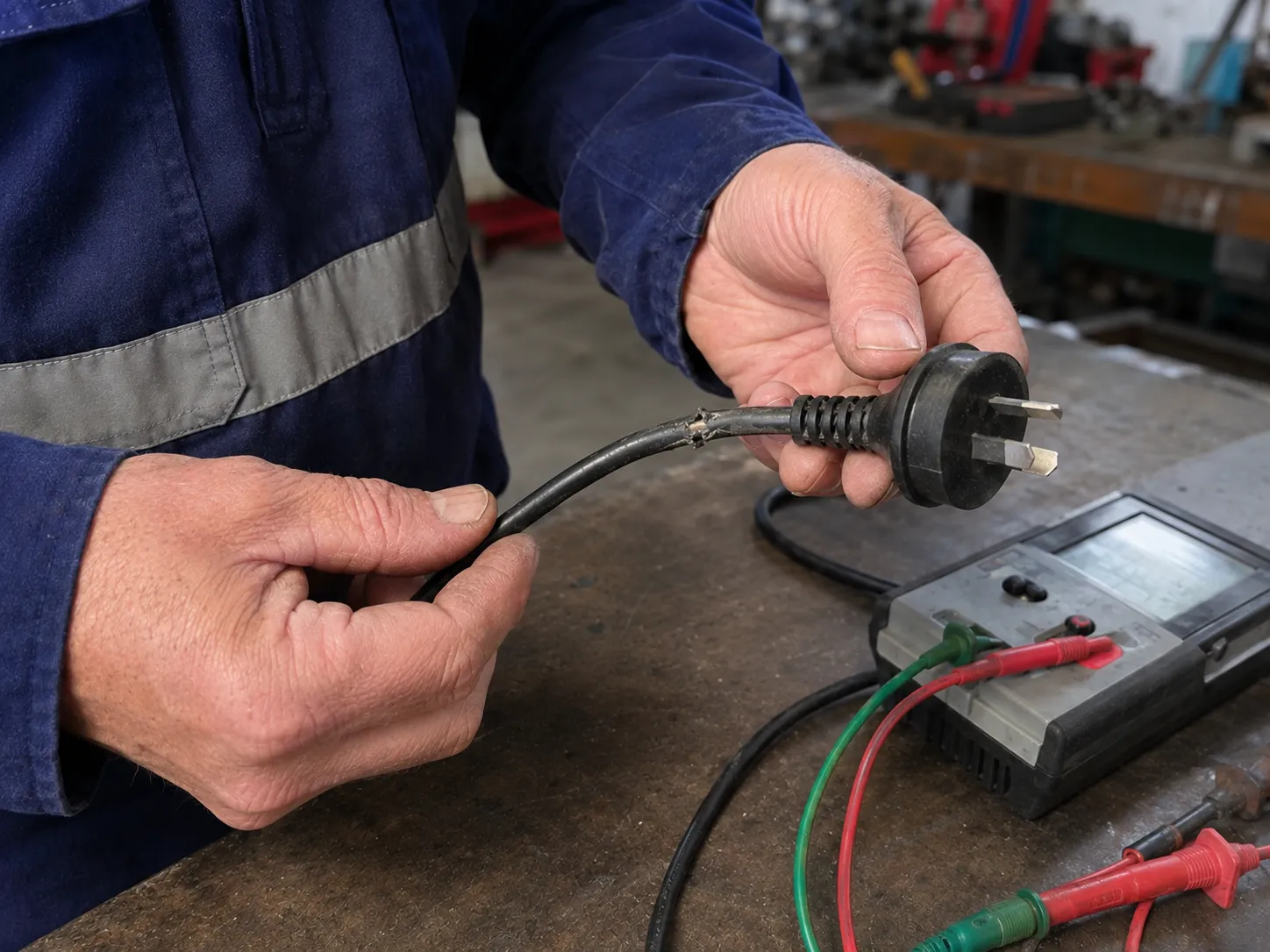
Damaged cords, plugs, power boards and portable tools can expose workers to electric shock, burns and other injuries. Electrical faults may also contribute to overheating or fires.
PCBUs must manage electrical risks so far as is reasonably practicable. Overdue testing, unsuitable testing arrangements, failure to isolate unsafe equipment or inadequate procedures can make it harder to demonstrate that electrical risks are being properly controlled.
Faulty equipment can interrupt work, damage property and create unexpected repair or replacement costs. Serious incidents may also result in significant downtime.
Poor records make it difficult to establish what was tested, when testing occurred, who performed it and what happened when equipment failed. Accurate records provide a useful history of equipment and help identify recurring problems.
Test and tag should form part of an ongoing electrical safety system rather than a once-off compliance exercise. Clear responsibilities, competent testing, appropriate schedules, worker reporting and prompt action on faults all help reduce electrical risk.
Keeping testing & tagging in Canberra compliant requires a consistent system rather than simply arranging an inspection when a tag expires. Canberra businesses can strengthen their processes by:
Keep an up-to-date record of equipment, locations, test results and due dates. Update the register when equipment is purchased, relocated, replaced or removed from service.
Set inspection and testing arrangements according to the equipment, its use and the workplace environment. Consider the requirements of AS/NZS 3760:2022 and specific ACT requirements that apply to higher-risk environments.
Ensure testing is performed by a person with the appropriate training, knowledge, skills and experience. Engage an appropriately licensed electrician when work falls outside routine inspection and testing.
Remove unsafe equipment from service, isolate it and ensure the fault is appropriately repaired or the equipment is replaced. Do not return repaired equipment to use until the required safety checks and testing have been completed.
Maintain accessible records of testing, failures and corrective actions. Review the programme when equipment, workplace conditions or work practices change.
A compliant process combines risk-based testing, competent personnel, accurate records, prompt fault management and regular review. Treating these activities as part of the broader WHS system helps Canberra businesses demonstrate that electrical safety is being actively managed.
Effective test and tag depends on clearly defined responsibilities and a consistent approach to electrical safety. The PCBU remains responsible for ensuring appropriate risk controls, testing arrangements and records are in place, while competent workers or providers, such as ETCS, can carry out testing and related services.
Workers also contribute by using equipment correctly, checking for visible damage and reporting faults promptly. When these responsibilities are clearly assigned and monitored, testing & tagging becomes more than a compliance task. It becomes a practical safety control that helps reduce electrical risks, support WHS obligations and protect people, equipment and business operations.

.svg)
.svg)


