
How Often Do You Need to Test and Tag in Tasmania?
March 16, 2026
Understanding how often electrical equipment must be tested and tagged in Tasmania is important for any business that wants to maintain safety, minimise disruption and stay compliant with workplace obligations. Different environments, from construction sites and workshops to offices and retail spaces, present different levels of electrical risk, which means testing intervals are not the same across every workplace. In this article, Electrical Testing & Compliance Service (ETCS) explains how test and tag requirements apply in Tasmania, how AS/NZS 3760 helps guide inspection frequencies and how factors such as environment, equipment type and day-to-day use affect how often items should be checked.
Readers will also gain a clearer understanding of the legal framework behind testing and tagging in Tasmania, the intervals commonly applied to different categories of equipment and the consequences of getting those schedules wrong. The article also outlines practical ways to build a compliant test and tag programme, with a focus on reducing downtime, supporting insurance defensibility and promoting a safer workplace. By the end, businesses will have a clearer picture of the testing intervals that apply to their operations and what is involved in maintaining compliance with confidence.
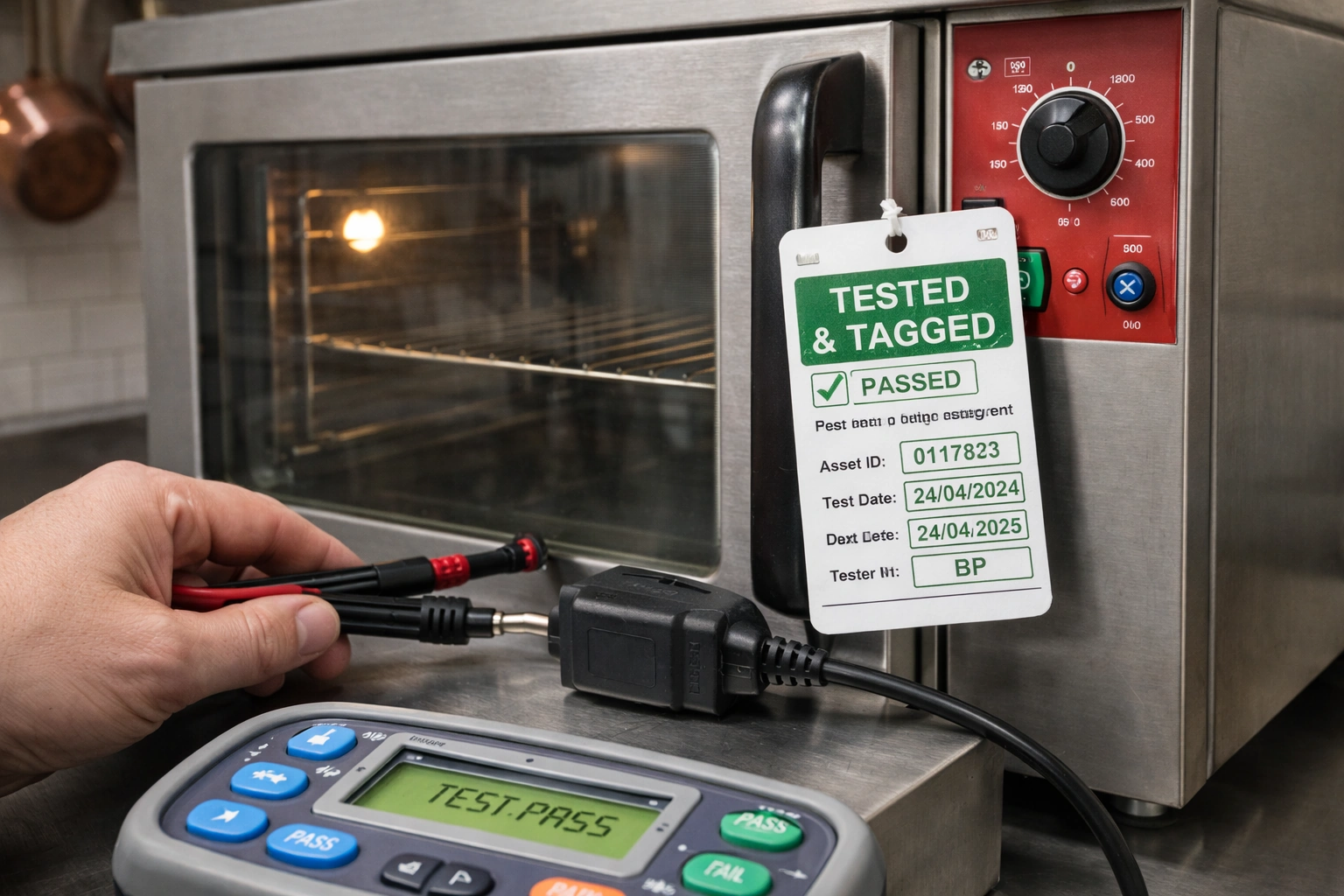
Tasmania’s testing and tagging requirements are set by national workplace safety laws that apply locally, along with specific Tasmanian guidance. Anyone running a business or undertaking in Tasmania must ensure electrical equipment is safe, used correctly and inspected at intervals that match the level of risk.
Test and tag specialists help businesses interpret these obligations in practical terms so that equipment is tested at the right frequency, records are kept correctly and workplaces are ready for a WorkSafe Tasmania inspection.
In Tasmania, electrical test and tag requirements are primarily driven by the Work Health and Safety Act 2012 and the Work Health and Safety Regulations 2012. These laws require a person conducting a business or undertaking to manage electrical risk so far as is reasonably practicable.
The regulations are supported by model Codes of Practice adopted in Tasmania and by Australian Standard AS/NZS 3760 in-service safety inspection and testing of electrical equipment. Although AS/NZS 3760 is technically a standard rather than an act, it is the accepted benchmark that inspectors, insurers and courts refer to when judging if electrical equipment has been maintained safely.
For workplaces with construction or demolition activities, AS/NZS 3012 electrical installations, construction and demolition sites apply. This standard sets tighter testing intervals and additional controls because those sites present higher electrical and environmental risk.
Under Tasmanian WHS law, the PCBU, usually the business owner or employer, has the primary duty to ensure that electrical equipment is inspected, tested and maintained so that it is safe. This duty covers:
Businesses must ensure that testing and tagging is carried out by a competent person. In practice, that means either a licensed electrician or a technician who has completed recognised test and tag training and uses suitable calibrated test instruments in accordance with AS/NZS 3760.
Workplaces must also ensure that out-of-service or failed equipment is clearly identified and removed from use until it is repaired or disposed of. Clear failed tags and isolation procedures help reduce confusion on site and make it easier to prevent unsafe equipment from being used.
Tasmanian workplaces are required to keep records of electrical test results for as long as the equipment remains in service or for the minimum period specified in the relevant standard. For portable equipment this usually means keeping at least the current and previous test records showing:
WorkSafe Tasmania inspectors can request evidence that electrical risks are being managed. In practice they will expect to see recent test tags on equipment that match written records and to confirm that test intervals align with AS/NZS 3760 or AS/NZS 3012 where relevant. Failure to comply can lead to improvement or prohibition notices, and in serious cases, fines or prosecution. Test and tag specialists help clients set up compliant registers and tagging regimes so that if an inspector visits, everything is clearly documented and up to date.
AS/NZS 3760 sets the minimum test and tag intervals for portable electrical equipment and RCDs used in workplaces across Tasmania. How often testing is required depends on the environment the equipment is used in and the risk of damage, not just the type of appliance. Test and tag professionals help businesses interpret these intervals correctly so equipment is neither overtested nor left unsafe for too long.
In practical terms this means a grinder on a construction site will need testing far more often than a computer in a low-risk office. Understanding which category your workplace falls into is essential to setting up a compliant schedule that aligns with AS/NZS 3760 and Tasmanian workplace safety expectations.
AS/NZS 3760 outlines typical maximum intervals based on the type of environment. Common examples include:
For Tasmanian workplaces, the correct interval depends on how and where each item is used. A drill used occasionally in a maintenance area inside an office building may justify a 12-month interval, while the same model used daily on a construction site will usually need testing every 3 months.
Residual current devices are covered alongside portable appliances in AS/NZS 3760. They have both push button and instrument test requirements.
In many workplaces portable or fixed RCDs protecting socket outlets should have:
On construction or demolition sites, RCDs are often subject to more frequent checks. Test and tag professionals can align RCD testing with appliance test cycles so power boards and RCD-protected outlets are inspected together, which reduces disruption while keeping records clear for compliance in Tasmania.
AS/NZS 3760 allows test intervals to be adjusted where there is evidence of greater or lower risk. If equipment shows frequent damage, repeated failed tests or a history of electric shock incidents, shorter intervals may be appropriate within the limits of the standard. For example, a site with repeated cord damage may move from 12-monthly to 6-monthly testing for hand tools.
Conversely, where low-risk conditions and a consistent history of safe test results are clearly documented, the interval may remain at the maximum allowed by AS/NZS 3760. Keeping detailed test records helps support any decision to vary intervals and provides useful evidence of compliance if the business is audited by WorkSafe Tasmania or an insurer.
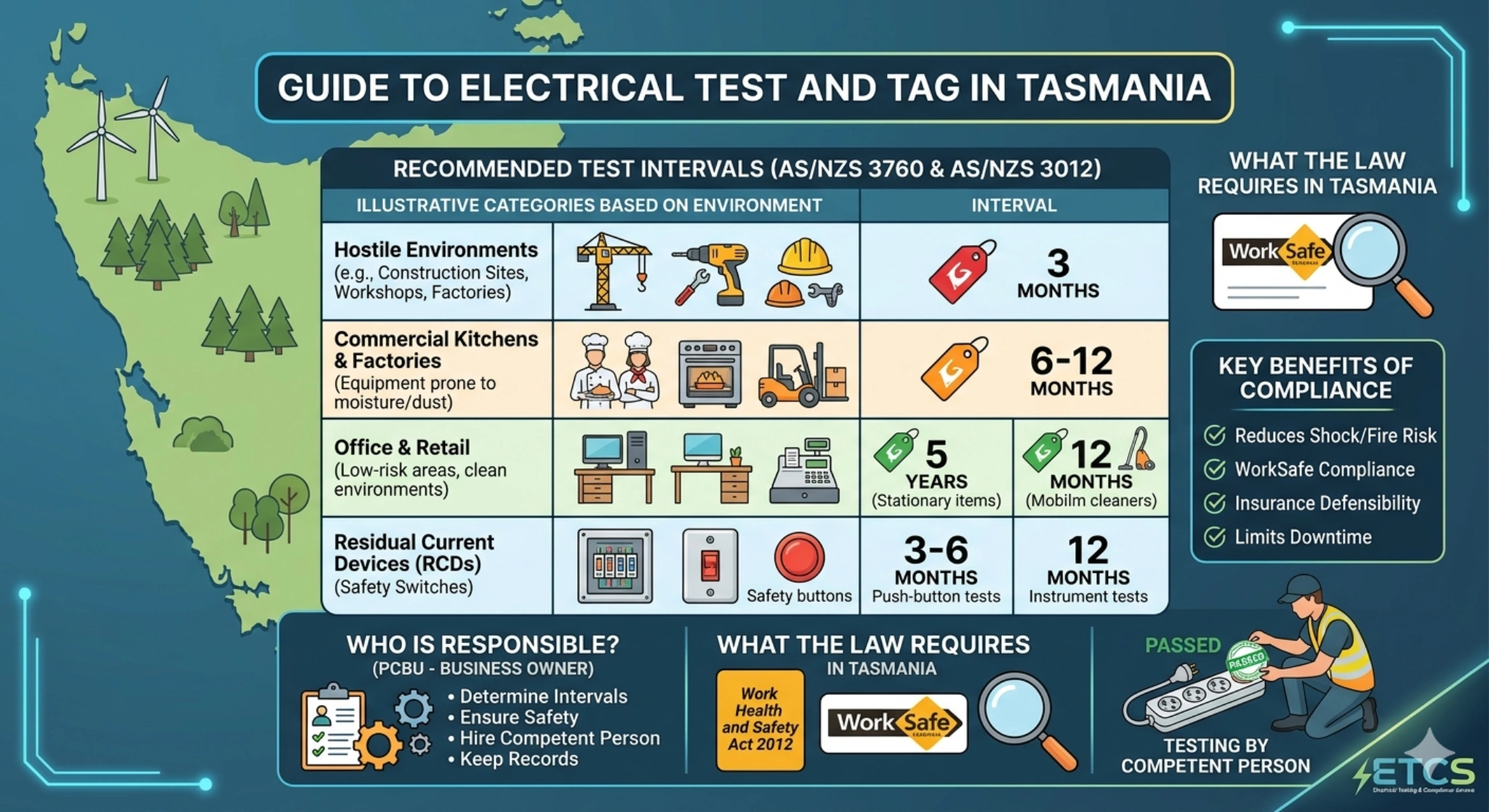
In Tasmania the required test and tag frequency is mainly driven by the type of workplace and how equipment is used. A laptop sitting in an office has a very different risk profile to a grinder on a construction site, so the test intervals are shorter where damage is more likely.
Test and tag professionals help businesses match their test and tag schedule to their actual environment while staying aligned with AS/NZS 3760 and local WHS expectations. Below are the typical patterns seen across common Tasmanian workplace types.
Construction, demolition and mining are treated as high-risk environments. Portable tools, extension leads and temporary power boards are moved often, used outdoors and exposed to moisture, dust and mechanical damage.
In these workplaces equipment usually needs:
For example, drills, grinders, welders, portable RCDs and leads on Tasmanian construction sites are generally tested every 3 months. If equipment is particularly exposed, such as on wet or corrosive sites, test and tag technicians may recommend even closer monitoring to prevent failures.
Workshops, manufacturing plants and warehouses are typically classified as hostile environments because equipment can be exposed to vibration, chemicals, dust, impact or frequent movement.
In these workplaces many items are tested:
Examples include power tools in mechanical workshops, portable lighting, floor cleaners, bench grinders and plug‑in machinery. Even if equipment appears in good condition, it must still be tested at the set interval because internal faults may not be visible. Test and tag technicians often map different zones within a facility, assigning shorter intervals to the harshest areas.
Standard offices, professional practices, most retail stores and similar indoor environments are usually considered non-hostile. Equipment is used in cleaner, drier locations and is moved less often, so the risk of damage is lower.
Typical intervals in these workplaces are:
Even in low-risk environments, some items still need more frequent attention. Cleaners’ equipment, kitchen appliances in lunchrooms and power boards under desks are more likely to be knocked, flexed or overloaded. Because of that, these items are often placed on shorter testing intervals than nearby IT equipment.
Many Tasmanian sites include a mix of conditions. An office with an attached workshop or a retail store with a wet preparation area will not have one single interval for the whole site.
In these mixed environments, the actual location and use of each item matters most. Appliances in kitchens, wet areas, outdoor patios, loading docks and plant rooms are treated more like workshop equipment, even if the rest of the building is office space. This risk-based approach keeps the business compliant while avoiding unnecessary over-testing of truly low-risk equipment.
Responsibility for testing and tagging in Tasmania sits primarily with the person conducting the business or undertaking, not the electrical contractor. Test and tag specialists can carry out inspections and tagging, but it is the business that must ensure the right equipment is tested at the right intervals and that records are kept.
In practical terms this means business owners, managers and PCBUs must put systems in place so equipment is identified, inspected, tested, tagged and maintained in line with Tasmanian work health and safety requirements and any applicable industry standards.
Under Tasmanian work health and safety laws, the primary duty of care rests with the PCBU. In most workplaces this will be the business owner, company or organisation that controls the workplace or directs the work.
Their responsibilities include:
Even if testing is outsourced, the legal responsibility for compliance does not transfer to the contractor. The business must still check that testing is being done correctly and that intervals match the relevant standard or regulator guidance for their industry.
Managers and supervisors are usually responsible for putting the business policy into practice day to day.
For example, they may:
On multi‑employer sites such as construction projects, the principal contractor or site controller normally coordinates overall testing requirements and site rules. However, each contractor still remains responsible for their own tools and equipment being tested and tagged.
Workers are not usually responsible for organising formal testing intervals, but they do have duties that affect compliance.
Every worker must:
If a worker notices a damaged cord or an expired tag, they must not keep using the item even if it has passed previous tests. Test and tag professionals often recommend simple pre‑use visual checks by workers to support the formal testing programme and help the PCBU meet its duty of care.
Failing to test and tag electrical equipment in Tasmania is not just a paperwork issue. It can expose a business or PCBU (person conducting a business or undertaking) to legal penalties, insurance problems and serious safety risks for workers, customers and visitors.
Tasmanian workplaces must meet the electrical safety provisions under the Work Health and Safety Act and Regulations. If equipment is not inspected and tagged at the required intervals, the business can be found non‑compliant even if no one has been injured.
WorkSafe Tasmania can investigate any workplace where electrical safety is in question. If inspectors find that test and tag requirements have been ignored or records are incomplete, they can:
Penalties depend on the level of risk and whether there has been an incident. Where there is a serious risk of electric shock or fire or someone has been injured, fines can be significant and can quickly exceed the cost of proper ongoing testing. In extreme cases repeated or reckless non‑compliance can contribute to prosecution under WHS laws.
Non‑compliance can also affect how an insurer responds after an incident. Many business and public liability policies expect the insured to maintain their workplace in a reasonably safe condition. If electrical equipment causes a fire or shock and there is no current test tag or test report, an insurer may:
This can leave the business paying for replacement equipment repairs to the premises and third‑party claims out of its own funds. It may also affect future premiums or the ability to obtain insurance at all.
From a practical point of view, the biggest consequence of not testing and tagging is increased risk of electric shock, fire and equipment failure. Faults like damaged cords, loose connections or failing insulation are often not visible and are typically picked up only through routine inspection and testing.
If WorkSafe Tasmania issues a prohibition notice, unsafe equipment must be taken out of service immediately. For many businesses this means unplanned downtime, cancelled jobs and lost income while urgent repairs and testing are arranged. In customer‑facing environments such as retail, hospitality, healthcare and education, visible non‑compliance can also damage reputation and reduce trust.
By keeping equipment on a regular test and tag schedule and maintaining proper records, test and tag technicians help Tasmanian businesses avoid these consequences and demonstrate that they are meeting their duty of care.
In Tasmania, test and tag compliance is not a one-size-fits-all process. The right testing interval depends on the environment, the type of equipment and how likely it is to be damaged through normal use. When businesses understand those differences, it becomes much easier to apply the right schedule and stay aligned with workplace safety requirements.
Keeping equipment on a consistent testing programme also does more than support compliance. It helps identify faults earlier, reduces the risk of electric shock and fire, limits avoidable downtime and gives businesses clearer records if they are ever asked to show how electrical risks are being managed. When approached properly, testing and tagging becomes a practical part of maintaining a safer and more reliable workplace.

.svg)
.svg)


