
How Often Should RCDs Be Tested in a Queensland Workplace?
June 16, 2026
Understanding how often residual current devices need to be tested is an important part of maintaining electrical safety in any Queensland workplace. Whether managing a construction site, industrial facility, retail premises or office environment, duty holders are responsible for ensuring critical safety devices are installed, maintained and tested correctly.
Much like broader electrical compliance programmes such as testing and tagging in Gold Coast workplaces, RCD testing helps reduce the risk of electric shock, supports legal compliance and contributes to a safer working environment.
ETCS regularly assists businesses in meeting these obligations through structured inspection and testing programmes. This article explains why RCD testing matters, how push-button testing differs from formal operating-time testing, what records should be kept and how testing requirements can vary across different Queensland workplaces.
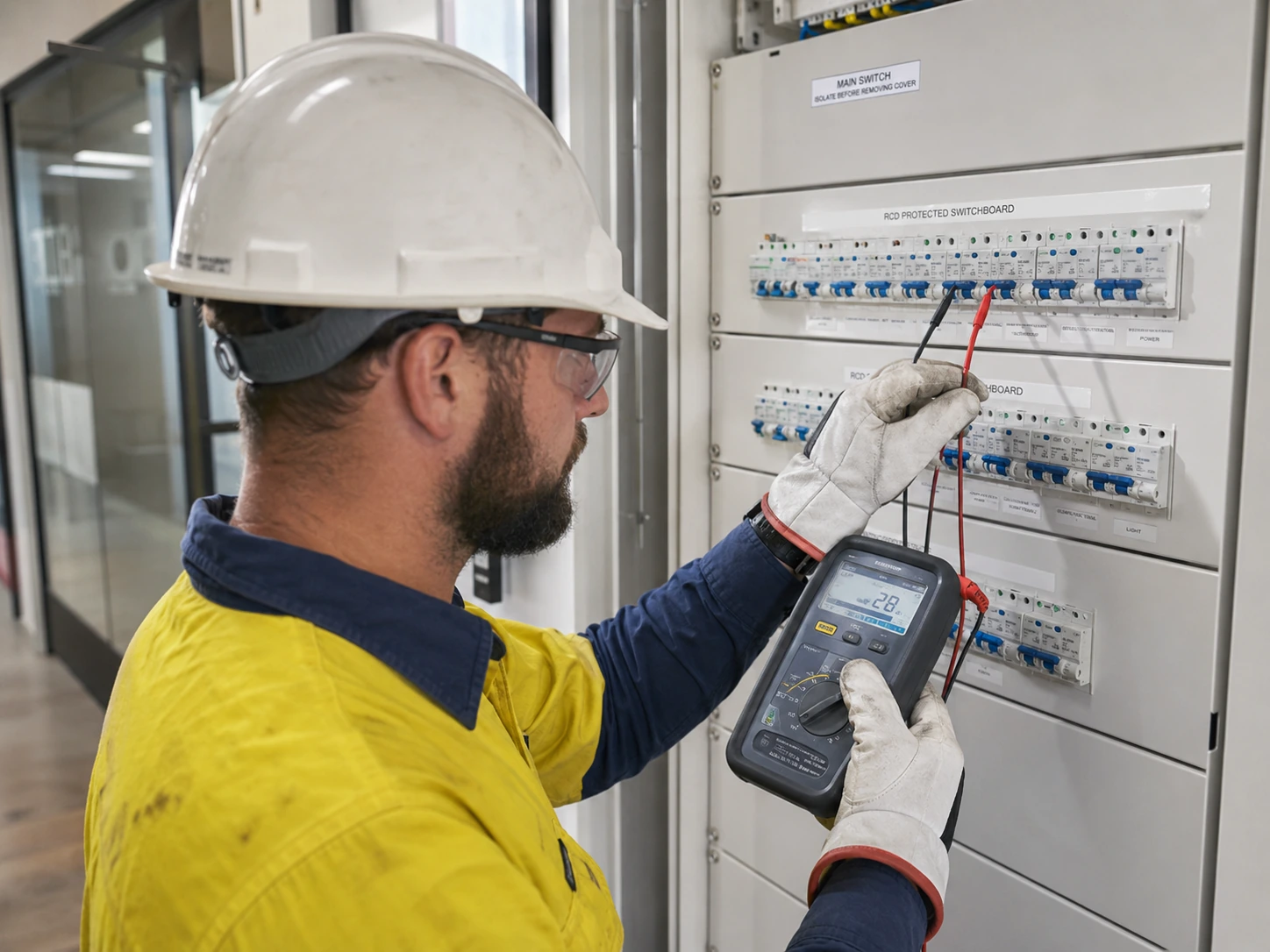
An RCD is a life-saving safety device designed primarily to reduce the risk of electric shock. It monitors the flow of electricity and disconnects the power supply very quickly if it detects an imbalance that may indicate current is leaking to earth.
RCDs can also help reduce some fire risks associated with earth leakage faults, although they do not replace circuit breakers, fuses or other protective devices. Because RCDs are relied on as a critical last line of defence, regular testing is essential to confirm they will operate correctly when needed.
RCDs and safety switches form part of workplace electrical risk management under Queensland electrical safety laws, workplace duties and relevant Australian Standards. Testing is not simply good practice. It supports due diligence and helps demonstrate that electrical risks are being managed so far as is reasonably practicable.
An RCD compares the current flowing in the active conductor with the current returning in the neutral conductor. Under normal conditions, the values are equal. If some current leaks to earth due to damaged insulation, a cut cable, faulty equipment or a person contacting live parts, the RCD senses the difference and disconnects the circuit.
In a typical workplace, RCD protection may be provided for:
Many workplace RCDs used for personal protection are rated at 30 mA. This is sensitive enough to reduce the likelihood of a fatal electric shock while helping avoid nuisance tripping during normal operation. However, the correct RCD type, rating and testing requirement depends on the installation, workplace environment and applicable standard.
RCDs are electro-mechanical devices that can deteriorate or fail without visible warning. Internal components can wear with repeated operations, contacts can become contaminated and wiring connections can loosen over time. Dust, moisture, vibration, heat and outdoor exposure can also affect performance.
Regular testing helps confirm two important points:
A device that trips too slowly, trips inconsistently or does not trip at all can create a false sense of security. This is especially serious in workplaces that use portable power tools, extension leads and electrical equipment in damp, dusty or outdoor locations where the risk of electric shock is higher.
Queensland workplaces have duties under electrical safety and work health and safety laws to identify electrical hazards and control risks. RCD protection and testing are part of this broader duty, particularly where workers use portable electrical equipment, temporary power, socket outlets or equipment in higher-risk environments.
Testing requirements can be influenced by several factors, including:
Formal testing using appropriate RCD test equipment and documented results helps demonstrate that electrical risks are being managed. It supports:
Without routine testing, businesses risk non-compliance, enforcement action and an increased likelihood of preventable electric shock incidents.
Push-button tests and operating-time tests both check RCD operation, but they do not measure the same thing. Both are important because they address different parts of RCD safety.
A push-button test is a simple in-service check. An operating-time test is a formal electrical test that measures the RCD’s performance under controlled test conditions. Relying on only one method can leave a gap in the testing programme.
The push-button test uses the inbuilt test button on the RCD, usually labelled “T” or “Test”. Pressing this button creates an artificial imbalance, which should cause the RCD to trip.
This confirms that the RCD can operate mechanically on that day. It is a useful check because it is quick, simple and can be carried out regularly with minimal disruption.
However, a push-button test does not measure how quickly the RCD trips. It also does not confirm whether the device operates correctly at its rated residual current or under the formal test conditions required for compliance.
An operating-time test uses dedicated RCD testing equipment. The tester applies a controlled test current and measures whether the RCD trips within the required time for that device and application.
This test helps verify whether the RCD performs as required under relevant Australian Standards. Depending on the test procedure and device type, it may check performance at different fault current levels, including half-rated and full-rated test currents.
For example, a 30 mA RCD protecting general-purpose socket outlets must trip quickly enough to provide effective personal protection. If it trips too slowly or fails to trip, the device must be treated as unsafe until the fault is investigated and corrected.
The push-button test provides frequent assurance that an RCD is still operating at a basic level between formal inspections. The operating-time test provides documented evidence that the RCD performs correctly under measured test conditions.
Push-button testing alone should not be relied on as the full workplace compliance check because it does not measure trip time or confirm formal performance requirements. Both tests work together as part of a practical and compliant electrical safety programme.
RCD testing intervals are not the same for every workplace. They depend on the type of work being performed, the risk level of the environment, whether the RCD is fixed or portable and which standard applies.
Construction and demolition sites generally require shorter testing intervals because temporary power systems, portable tools, leads and site equipment are exposed to more movement, weather and mechanical damage. Lower-risk office environments may have longer intervals, provided the equipment and environment remain controlled.
The table below gives a general guide only. Specific intervals should always be confirmed against the applicable standard, Queensland regulatory requirements and the site’s risk assessment.

Businesses managing portable electrical equipment should also understand test and tag colour codes and retest intervals, particularly where equipment is used across construction, workshop or shared commercial environments. While RCD testing has its own requirements, colour-coded tagging can help sites keep broader electrical safety inspections organised and easy to verify.
Construction and demolition sites are treated as high-risk electrical environments. Cables, tools, leads and temporary switchboards are frequently moved, exposed to weather and subject to mechanical damage.
On these sites, testing intervals are typically shorter and should be managed in line with AS/NZS 3012 and the site’s electrical safety procedures. Portable RCDs used with temporary power, extension leads and plug-in equipment are generally checked more frequently, including regular push-button checks and formal operating-time testing at prescribed intervals.
Fixed RCDs, temporary switchboards and transportable structures should also be included in the site’s testing schedule. Because conditions can change quickly on construction sites, RCD testing should form part of the broader system for managing temporary power, site inspections and equipment compliance.
Workshops, factories and industrial facilities can present moderate to high electrical risk, particularly where portable equipment is used or where dust, moisture, heat, vibration, metalwork or conductive flooring are present.
In these environments, RCDs should be checked regularly as part of the site’s electrical safety programme. The required interval may vary depending on whether the device is fixed or portable, how often the connected equipment is used and whether the environment is considered hostile.
Fixed RCDs supplying hard-wired equipment in a clean, controlled area may be tested less frequently than portable RCDs used with tools and extension leads. However, where equipment is frequently moved or exposed to harsh conditions, shorter testing intervals are usually more appropriate.
Offices, retail spaces and similar commercial environments generally have lower electrical risk than construction or industrial sites. Equipment is usually used indoors, movement is limited and exposure to moisture or mechanical damage is lower.
However, RCD testing is still an important compliance requirement. Office and retail workplaces may also contain higher-risk areas such as kitchens, storerooms, outdoor power points, maintenance areas or public-access outlets. These circuits may need closer attention than general office power circuits.
Where the workplace changes layout, adds equipment or introduces new electrical loads, the RCD testing schedule should be reviewed to make sure it still matches the risk profile of the site.
Fixed and portable RCDs both require regular testing, but the testing schedule may differ. The key factor is not only whether the RCD is fixed or portable, but also where it is used and what level of risk is present.
A portable RCD used daily with power tools on a construction site is exposed to very different conditions from a fixed RCD protecting office power circuits. Testing programmes should reflect these differences.
Fixed RCDs are installed in switchboards or distribution boards and protect one or more circuits. These devices generally require two types of testing:
Because fixed RCDs protect entire circuits, testing should be planned carefully. Tripping a fixed RCD can interrupt power to workstations, equipment, refrigeration, servers or other critical loads. For this reason, formal testing should be scheduled around operational demands so circuits can be safely isolated and restored.
If a fixed RCD fails, nuisance trips repeatedly or appears to be incorrectly installed, a licensed electrician should inspect the device and connected circuit.
Portable RCDs include plug-in RCD adaptors, RCD-protected power boards and devices used with appliances, tools or extension leads. These are often treated similarly to portable electrical equipment because they can be moved between locations and exposed to greater wear.
Portable RCDs are generally tested more frequently than fixed RCDs, especially in hostile or high-risk environments. Depending on the workplace, testing may include:
Construction and demolition sites sit at the strictest end of this range. Clean indoor workplaces using portable RCDs only occasionally may have longer intervals, provided the testing schedule is supported by the site’s risk assessment and applicable standard.
Accurate records are a legal and practical necessity. Test reports show that the workplace has taken steps to manage electrical safety risks and can provide important evidence if an incident, audit or inspection occurs.
Records should be clear, legible and easy to retrieve. They may be kept electronically or in hard copy, provided they are secure, backed up and controlled.
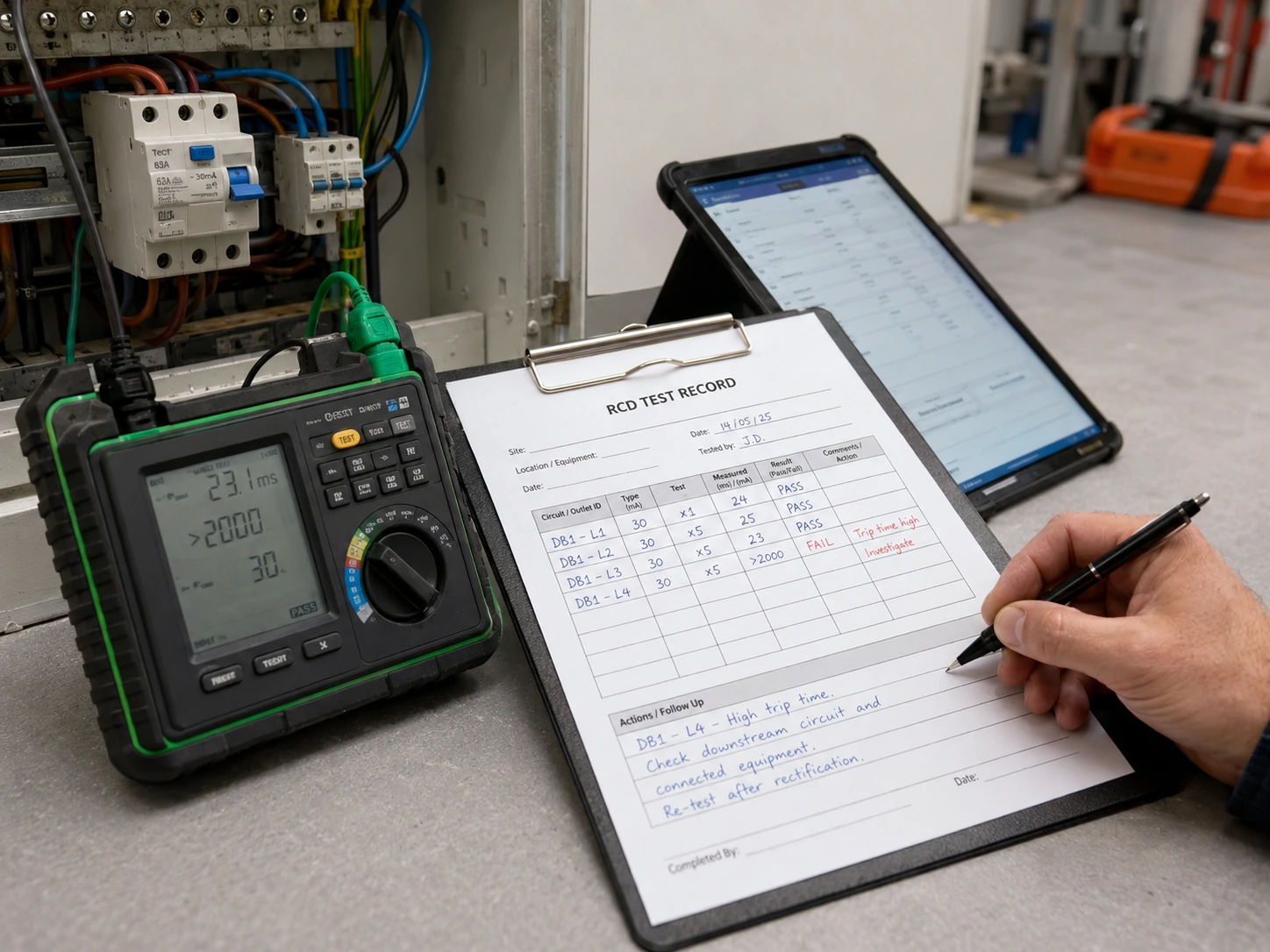
Each RCD should be uniquely identifiable and linked to its test results. Records should include:
The record should contain enough information to demonstrate that the RCD has been tested correctly and that any failures have been managed.
If an RCD fails, the record should do more than simply state “failed”. It should clearly explain what happened and what action was taken.
Good records should include:
Where an RCD is removed from service, the record should make this clear so it is not mistaken for an operational device during future inspections. Any temporary controls used while the circuit is without RCD protection should also be documented.
If an RCD fails any part of its test, it must be treated as unsafe until the issue is investigated and corrected. The priority is to remove the electrical risk immediately, then arrange repair, replacement or further inspection as required.
A failed RCD should not be treated as a minor issue or monitored without action. Continued use of a non-compliant RCD can expose workers to serious harm and may place the business in breach of its electrical safety duties.
As soon as an RCD fails a push-button test, operating-time test or trip-current test, the protected circuit or portable device should not remain in normal use.
In practice, this may involve:
For portable RCDs, the device should be unplugged, labelled as failed and kept out of use until it has been assessed and passed.
Only a licensed electrician is permitted to repair, modify or replace fixed RCDs in Queensland. After a fixed RCD fails, a licensed electrician should inspect the device, wiring and connected circuit.
In some cases, the RCD itself may be faulty. In other cases, the issue may involve incorrect wiring, a fault on the protected circuit, unsuitable coordination with other protective devices or a connected appliance causing leakage current.
If the RCD is faulty, it should be replaced with a suitable device that meets current Australian Standards. Any wiring or installation defects should also be rectified so the RCD can operate correctly.
After repair or replacement, the RCD must be fully retested and must pass before the circuit is returned to service.
When an RCD fails, the workplace should record the failure and review whether further action is needed.
This may include:
A failed RCD may indicate a broader issue with the electrical installation, environmental conditions or maintenance schedule. Reviewing the failure helps reduce the chance of similar faults being missed.
RCD testing is a fundamental part of electrical risk management in Queensland workplaces. The required testing frequency depends on the type of workplace, level of risk, environment and whether the RCD is fixed or portable.
Regular push-button checks, formal operating-time testing and accurate record-keeping help verify that RCDs will operate effectively when needed. They also provide evidence that the business is actively managing electrical safety risks.
Working with an experienced provider can help ensure RCD testing programmes are correctly scheduled, professionally documented and aligned with current regulatory requirements.

.svg)
.svg)


