
Microwave Leakage Testing: When Is It Needed in a Workplace?
July 23, 2026
Microwave ovens are common in workplace kitchens, break rooms and shared facilities. Although they are simple plug-in appliances, they use non-ionising radiofrequency electromagnetic energy to heat food, which must remain safely contained within the appliance.
Concerns about microwave leakage may arise after visible damage, unusual operation, repairs or reports from staff. However, leakage testing is a separate assessment from routine electrical inspection and testing, and not every workplace microwave automatically requires periodic leakage testing.
Alongside professional testing and tagging in Tasmania, ETCS can help businesses assess workplace appliances and determine when a separate microwave leakage test may be appropriate.
Understanding when leakage testing is necessary helps employers respond appropriately to damage, manage electrical and radiation-related risks and avoid unnecessary testing. This article explains the warning signs to look for, what leakage testing involves and what should happen when a microwave is found to be unsafe.
Microwave ovens are generally safe when they are maintained in good condition and used according to the manufacturer’s instructions. However, workplace appliances can experience frequent use, rough handling, food contamination and limited supervision.
Doors may be slammed, hinges can become loose and food residue may build up around the door edges. Staff may also place unsuitable materials inside the appliance or continue using it after sparks, unusual noises or burning smells have occurred.
These conditions can contribute to:
Regular visual checks and prompt reporting of damage are therefore important. Where a defect could affect the microwave’s ability to contain energy safely, a formal leakage assessment may also be required.
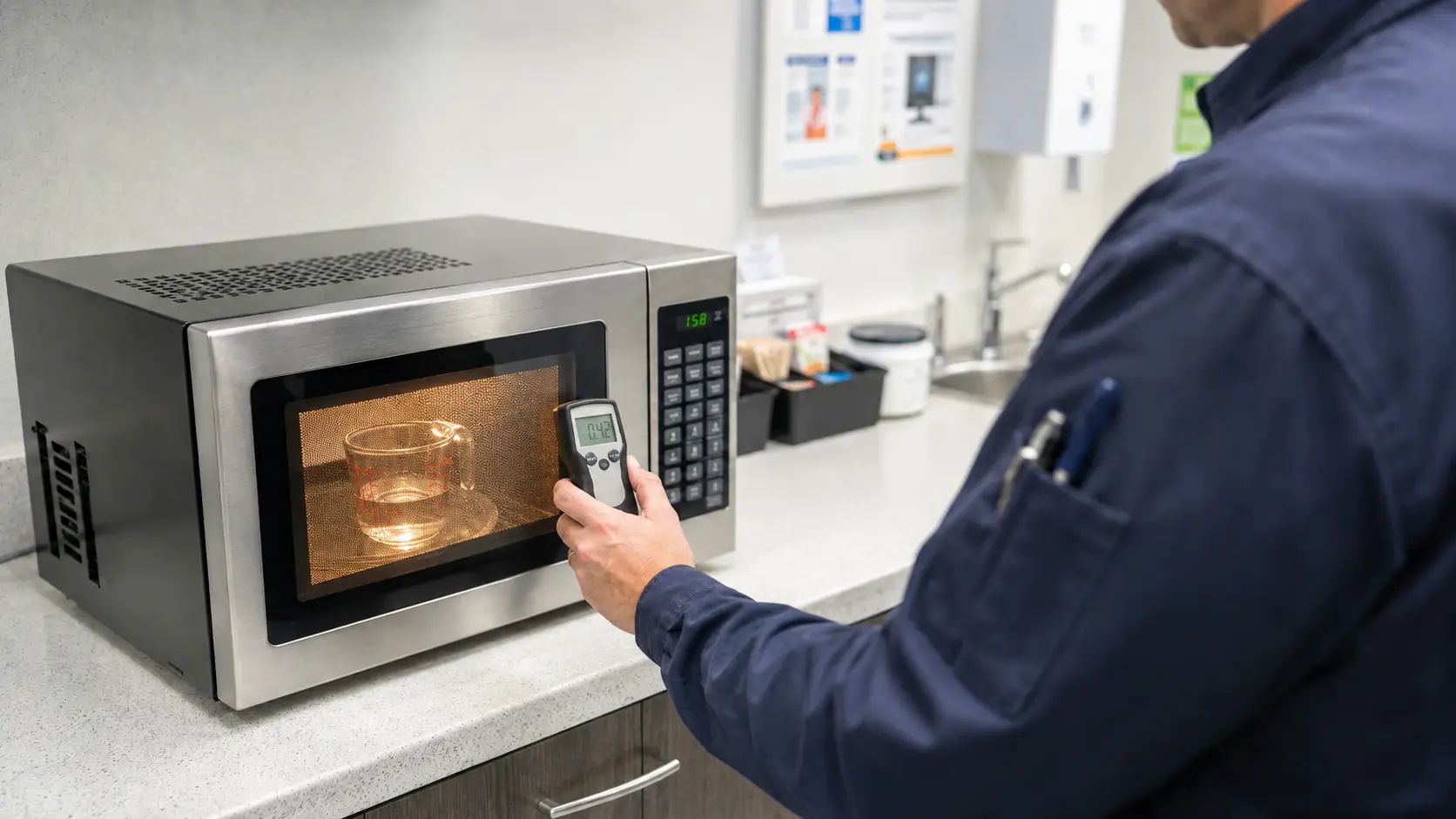
Workplace microwaves do not generally require scheduled leakage testing simply because they are located in an office, staff room or commercial workplace.
There is no universal Australian requirement for domestic-style microwave ovens to undergo routine periodic leakage testing after they have been placed in service. Leakage testing is normally arranged when there is a specific reason to suspect that the appliance’s shielding, door assembly or safety systems may have been compromised.
Testing may be appropriate:
A business may voluntarily include microwave leakage testing in a broader appliance-maintenance programme, particularly in high-use settings. However, it should be described as a risk-based control rather than a compulsory test for every workplace microwave.
Microwave leakage testing should not be confused with electrical inspection and testing.
Electrical testing focuses on hazards such as:
Under workplace safety requirements, electrical equipment may need regular inspection and testing when it is used in conditions that are likely to cause damage or reduce its expected lifespan. This may include exposure to moisture, heat, vibration, chemicals, dust or mechanical damage.
An ordinary microwave in a clean, low-risk office kitchen may not automatically require the same testing interval as equipment used in a harsh workshop, commercial kitchen or industrial environment. Appropriate testing intervals based on workplace risk should consider the environment, the type of equipment and the likelihood of damage.
Microwave leakage testing measures radiofrequency energy escaping from the appliance while it is operating.
It is primarily concerned with the integrity of:
A leakage test does not replace electrical safety testing. It also does not, by itself, confirm that the microwave is heating efficiently or producing stable cooking power. Performance problems require separate servicing or output testing.
Staff should be encouraged to report any change in a microwave’s physical condition or operation. A damaged or abnormal appliance should be removed from service rather than left in use until the next scheduled inspection.
The door assembly is one of the most important parts of a microwave’s containment system.
Warning signs include:
The microwave should not be used when the door cannot close securely or sit correctly against the frame.
Food spills and moisture can contribute to corrosion when the microwave is not cleaned properly.
The appliance should be assessed if there is:
Minor surface marks do not always indicate microwave leakage, but extensive corrosion or structural damage should not be ignored.
Changes in how the microwave sounds, smells or behaves can indicate an electrical or internal fault.
Warning signs include:
Some sparking may result from unsuitable containers, foil or food residue. However, repeated sparking after the cavity has been cleaned and suitable cookware is used requires further investigation.
Microwave leakage testing is a non-intrusive process carried out while the appliance operates with a suitable test load inside.
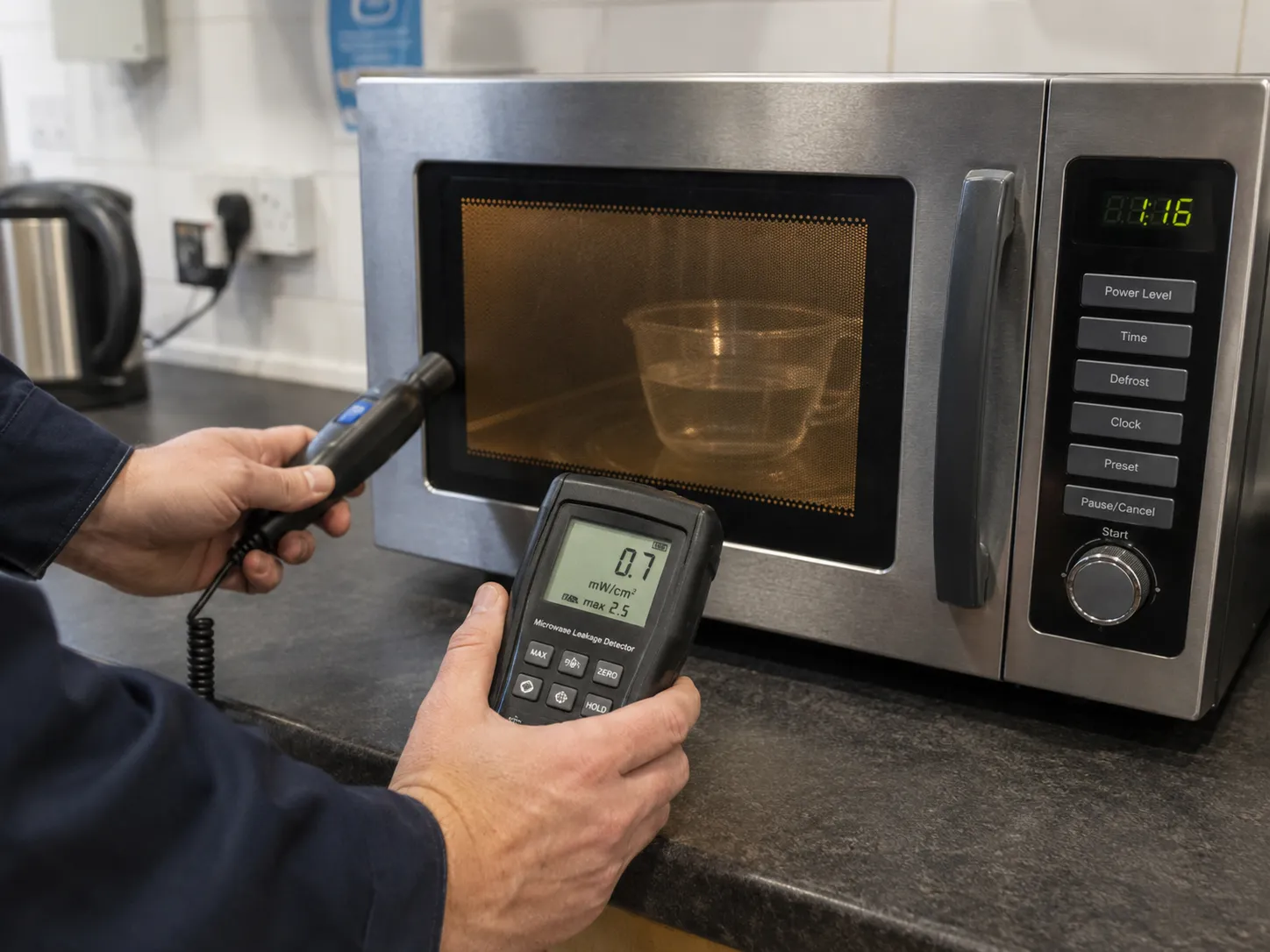
A competent person uses an appropriate, calibrated microwave leakage detector to measure energy around potential leakage points. The test should follow the instrument manufacturer’s instructions and the applicable testing procedure.
Before taking measurements, the person carrying out the assessment should examine the microwave for defects that could affect safety or influence the results.
The inspection may include:
The microwave may need to be removed from service immediately if serious damage is identified, regardless of whether a leakage measurement has been completed.
The microwave is operated with a suitable load, commonly water, to prevent it from running empty. The detector is then moved around the door perimeter, viewing window, vents and other potential leakage points at the speed and distance required by the testing procedure.
The highest measured value should be recorded and compared with the applicable acceptance criterion.
The process should be completed using:
Door interlocks prevent the microwave from operating when the door is open. Their operation may be checked as part of the overall assessment, but this is a separate functional check from measuring leakage.
No one should bypass, adjust or interfere with microwave interlocks unless they are appropriately trained and authorised to service the appliance.
A passing result means the measured leakage was within the applicable acceptance criterion at the time of testing.
It does not guarantee that:
The result should therefore be considered together with the visual inspection, electrical condition and functional operation of the appliance.
A microwave may still need repair or replacement when it passes the leakage measurement but has other defects, such as a damaged cord, faulty controls, severe corrosion or unreliable operation.
Leakage testing is most useful when there is a clear trigger suggesting that containment may have been affected.
Testing should be considered after:
The appliance should remain out of service until it has been inspected and found safe.
A leakage test may be required after repairs or adjustments involving:
Testing after repair helps confirm that the work has not affected the microwave’s ability to contain energy.
Electrical repair work may also require separate electrical safety testing before the appliance is returned to service.
A change in workplace use does not automatically require leakage testing. However, it may justify reviewing the appliance’s condition and maintenance arrangements.
Examples include:
The workplace should consider whether additional inspections, staff instructions or maintenance controls are appropriate for the new conditions.
A microwave that exceeds the applicable leakage criterion should be treated as unsafe and removed from service immediately.
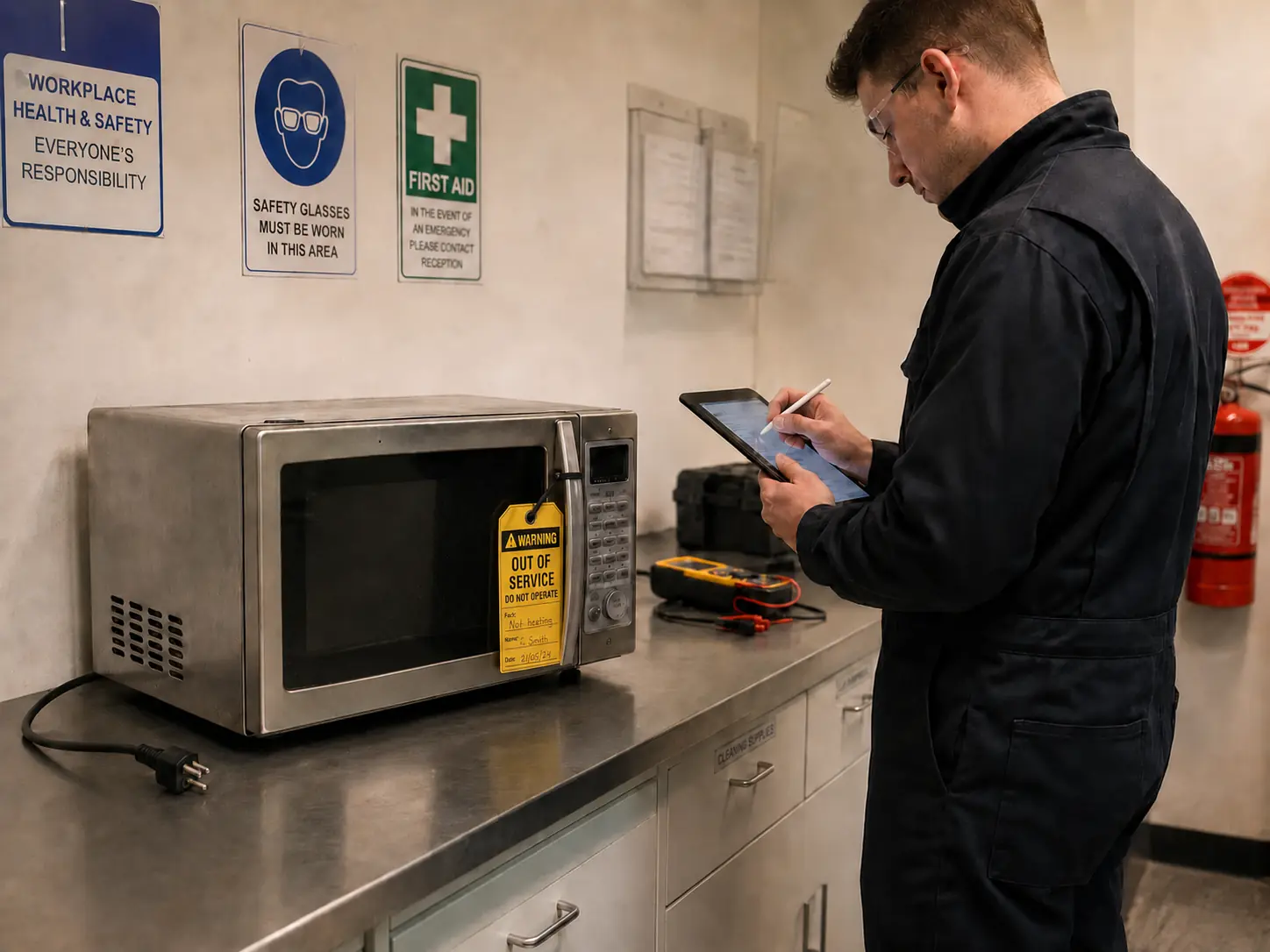
It should not remain in a staff kitchen with only a verbal warning. Clear controls are needed to prevent another person from plugging it back in.
The appliance should be:
Staff should not attempt makeshift repairs, bend the door back into place or adjust the latch in an effort to achieve a passing result.
Depending on the defect, the microwave may be repaired by a qualified appliance technician using suitable parts and procedures.
After repairs affecting the door, shielding or safety systems, the microwave should be retested before being returned to service. Any required electrical safety testing should also be completed.
Records should show:
Replacement may be more practical when the microwave is old, heavily corroded or extensively damaged.
A decommissioned microwave should be:
Clear records help businesses demonstrate that reported defects were assessed and that unsafe equipment was removed, repaired or replaced.
For a microwave leakage assessment, useful records include:
Recording the actual measurement provides more useful information than simply recording “pass”. However, small differences between readings do not necessarily show deterioration, particularly when different instruments, conditions or testing methods have been used.
Records should be kept in accordance with the organisation’s safety procedures, maintenance programme, insurer requirements, contractual obligations and any applicable industry rules. They should also remain accessible for internal reviews or workplace inspections.
Leakage testing is only one possible part of microwave safety. Everyday maintenance and staff behaviour are equally important.
Businesses can reduce risks by:
Staff should also understand that unusual smells, sounds, sparks or door problems must be reported rather than ignored.
Microwave ovens do not generally require routine leakage testing solely because they are used in a workplace. However, employers still need to maintain appliances, respond to visible damage and control electrical and operational hazards.
Leakage testing may be appropriate when the door, hinges, latches, shielding or cooking cavity have been damaged, after relevant repairs or where a specific workplace risk assessment or industry requirement calls for it. This assessment should remain separate from electrical inspection and testing, which addresses different hazards.
By combining visual checks, appropriate electrical safety measures, prompt fault reporting and targeted leakage testing when necessary, workplaces can manage microwave safety without relying on unnecessary or unsupported testing schedules. ETCS helps Tasmanian businesses assess workplace appliances and implement a consistent, risk-based approach to electrical safety and compliance.

.svg)
.svg)


